

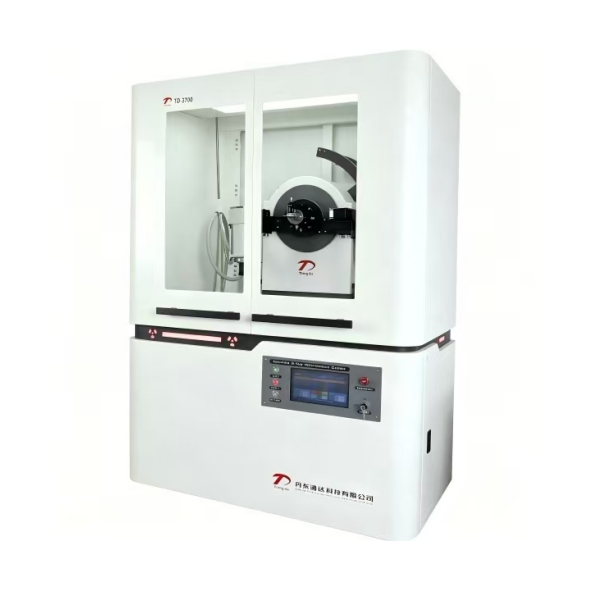
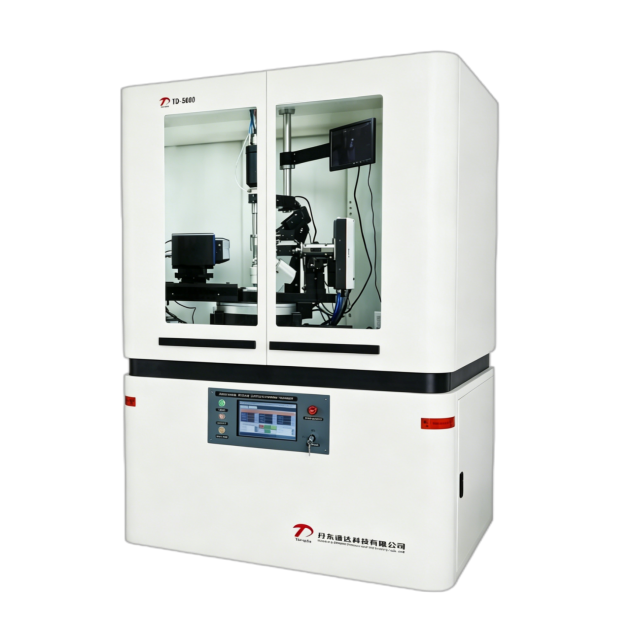
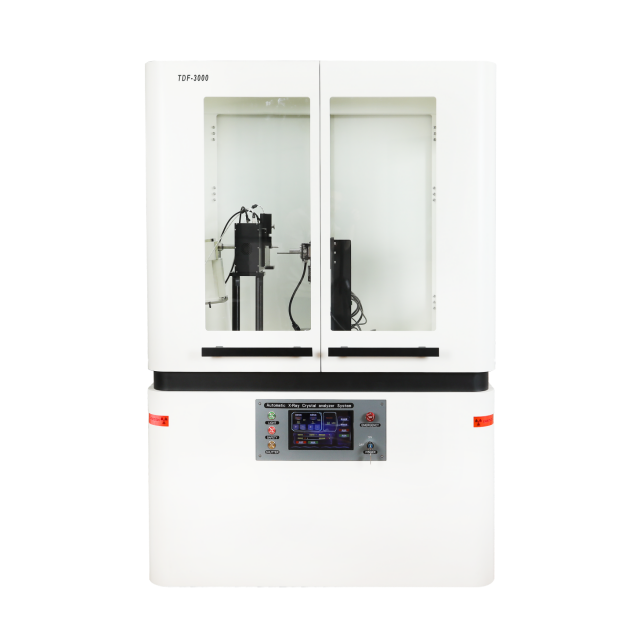
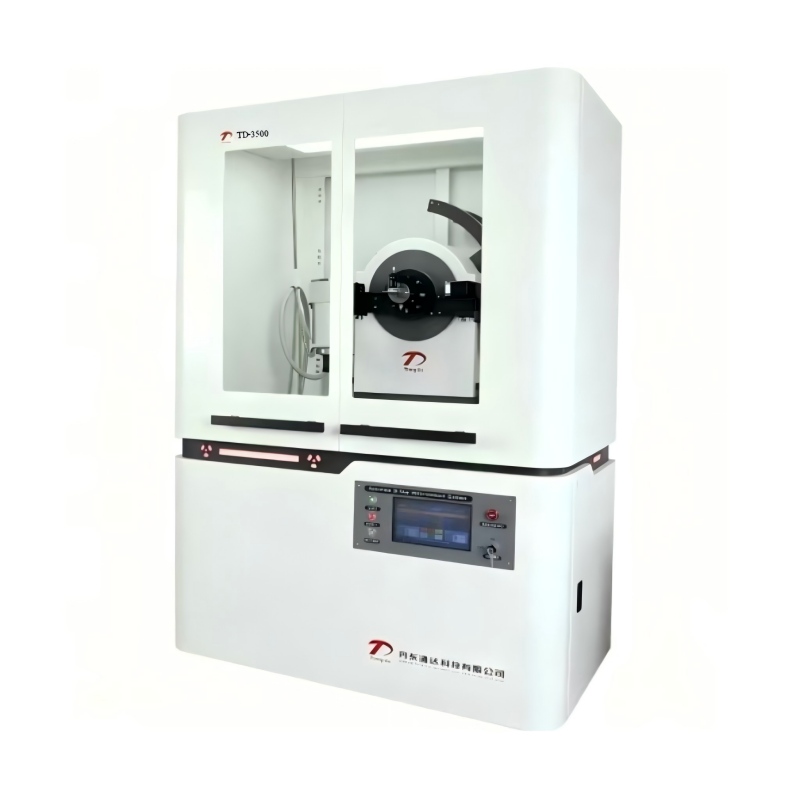
The working principle of an X-ray diffractometer is based on the phenomenon of X-ray diffraction. When a beam of X-rays strikes a crystal at a certain angle θ, the atoms or molecules inside the crystal scatter the X-rays. Due to the periodic arrangement of atoms or molecules within the crystal, these scattered waves interfere with each other, resulting in constructive interference (amplification) in certain directions and destructive interference (cancellation) in others. These enhanced or reduced scattered waves form diffraction patterns in specific directions in space, known as diffraction spectra. This process strictly follows Bragg's law: 2d sinθ = nλ, where d is the interplanar spacing, λ is the X-ray wavelength, and n is the diffraction order. By varying the incident angle θ and recording the corresponding diffraction intensity, a series of characteristic diffraction peaks can be obtained. The position and intensity of each peak directly reflect the spacing of specific crystal planes and the density of atomic arrangement within the crystal.
The diffraction angle θ and diffraction intensity I in the diffraction pattern contain structural information about the crystal. By measuring and analyzing these diffraction data, one can determine the crystal lattice type, unit cell dimensions, and the positions and orientations of atoms within the unit cell. In addition, X-ray diffractometers can be used to study properties such as crystal orientation, degree of crystallinity, texture, and stress. For example, in materials science, the broadening of diffraction peaks can be used to calculate the grain size of nanomaterials; peak shifts can be analyzed to evaluate residual stress; and different phases possess unique combinations of diffraction peaks, serving as fingerprints for qualitative and quantitative phase analysis.
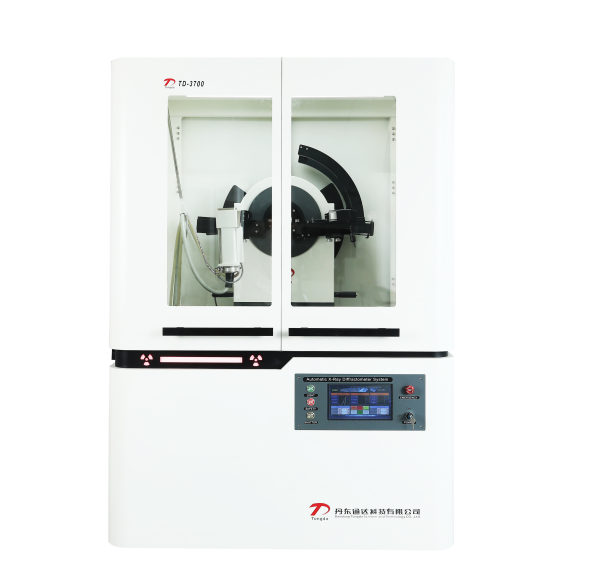
The core components of an X-ray diffractometerinclude a highly stable X-ray source, a sample and orientation adjustment mechanism system, a radiation detector, and a diffraction pattern processing and analysis system. The X-ray source generates X-rays; the sample and adjustment system ensure that the sample is positioned at the correct angle and orientation to receive X-ray irradiation; the radiation detector measures the intensity of diffracted X-rays and converts it into electrical signals for recording; and the diffraction pattern processing and analysis system handles and interprets the recorded diffraction data. Modern diffractometers are often equipped with θ-θ or θ-2θ coupled scanning mechanisms, enabling precise measurement of various sample forms such as powders, bulk materials, and thin films.

In summary, the working principle of an X-ray diffractometer Метод основан на рентгеновской дифракции. Измеряя и анализируя угол дифракции и интенсивность дифракционной картины, он позволяет получить информацию о структуре кристаллов и служит важным инструментом для анализа структуры материалов.